
Permanent Hair Dye vs Semi-Permanent: Which is Right for You?
Hair Dye, Home Hair Colour, Hair Care, Semi-Permanent, Permanent Hair Colour
Confused by permanent hair dye vs semi-permanent? Discover the differences, pros, cons, and how to choose the right hair dye type for your home colour.
Choosing to dye your hair at home is an exciting way to refresh your look, but standing in the hair colour aisle can feel overwhelming. With so many boxes promising vibrant results, the biggest decision you'll face is choosing between permanent hair dye and semi-permanent options. Understanding the different hair dye types is crucial because each formula behaves differently, requires different application methods, and offers varying levels of commitment and coverage.
In this guide, we'll break down exactly how these dyes work, what you'll need to apply them, and how to decide which one is right for your hair goals.
How Hair Dye Works: The Science Behind the Colour
To understand which dye is right for you, it helps to know a little about hair anatomy. Your hair shaft has an outer layer called the cuticle (which looks like microscopic roof tiles) and an inner core called the cortex, where your natural pigment lives.
Permanent Hair Dye
Permanent hair dye creates a lasting chemical change [8]. It uses an alkalising agent (usually ammonia) and a developer (hydrogen peroxide) to lift the cuticle, remove some of your natural pigment, and deposit new colour molecules deep inside the cortex [5, 8]. Because the colour is locked inside the hair structure, it won't wash out, though it may fade slightly over time [6].
Semi-Permanent Hair Dye
Semi-permanent dye is much gentler. It contains no ammonia and requires no developer [8]. Instead of penetrating the cortex, the colour molecules simply coat the outside of the hair shaft, acting like a stain [2, 8]. Because it only sits on the surface, it gradually washes away with each shampoo.
Demi-Permanent Hair Dye
Sitting right between the two is demi-permanent hair dye. This formula uses a very low-volume developer to gently open the cuticle just enough to deposit colour slightly beneath the surface [5, 8]. It lasts longer than semi-permanent dye but doesn't permanently alter your natural hair structure [3, 10].
Permanent vs Semi-Permanent: Pros and Cons
Permanent Hair Dye
Best for: Complete grey coverage, lightening your hair, or making a dramatic, lasting change.
- Pros: Lasts indefinitely [5]; provides 100% grey coverage [8]; can lighten natural hair (usually up to 2-3 levels with standard box dyes).
- Cons: Requires commitment; leaves a visible root line as hair grows [5]; chemical processing can cause dryness or damage if overused.
Semi-Permanent Hair Dye
Best for: Trying a new shade, boosting shine, or refreshing faded colour without commitment.
- Pros: Zero damage (no ammonia or developer) [8]; easy to apply at home; fades naturally without a harsh root line.
- Cons: Cannot lighten hair [6]; washes out quickly (usually 4-12 washes); will not fully cover grey hair (only blends it).
Demi-Permanent Hair Dye
Best for: Blending first greys, darkening your hair, or toning brassiness.
- Pros: Lasts up to 24-28 washes [7, 10]; fades smoothly without a harsh regrowth line [4]; leaves hair incredibly glossy.
- Cons: Cannot lighten hair [5, 10]; requires mixing with a low-volume developer.
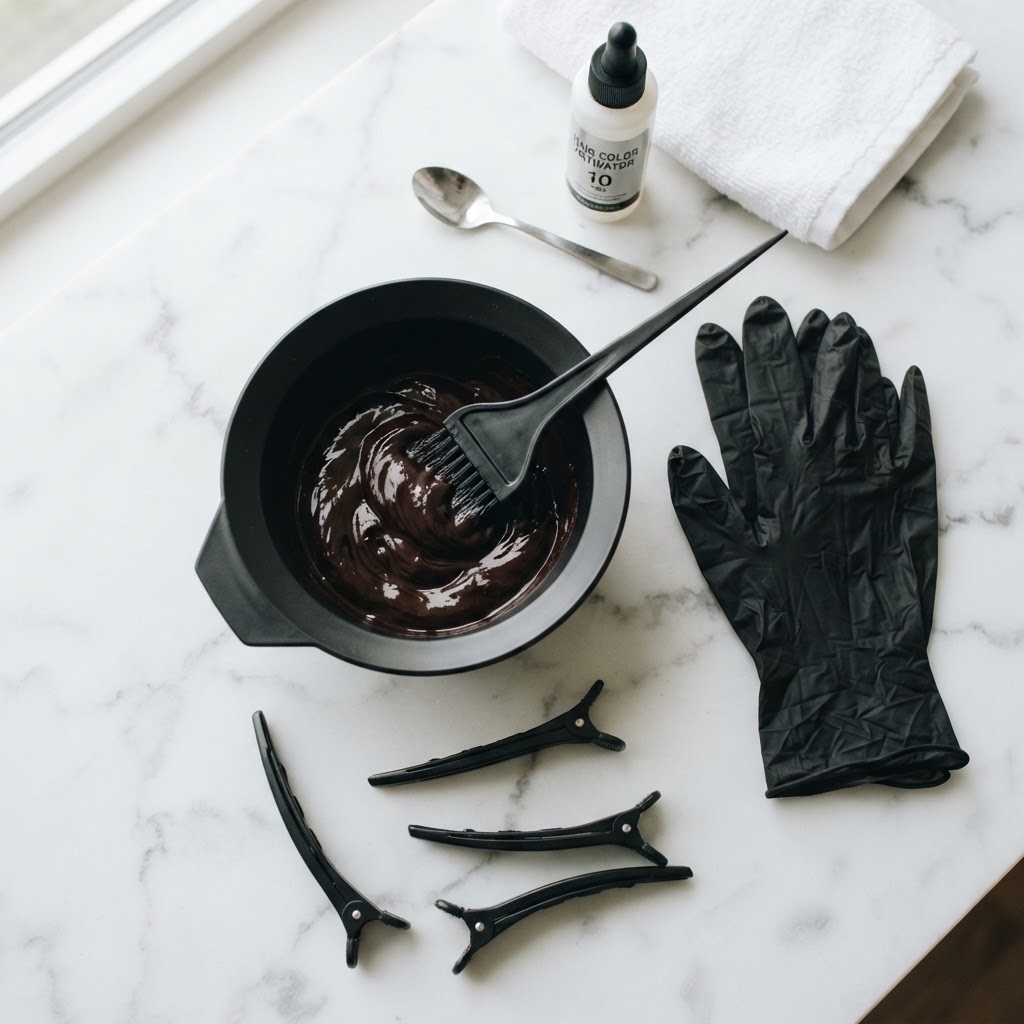
What You'll Need for Home Colouring
Before you begin, gather your supplies. Being prepared is the secret to a salon-worthy result.
- Your chosen hair dye: Buy two boxes if your hair is past your shoulders or very thick.
- Barrier cream: Petroleum jelly or a thick moisturiser to protect your hairline and ears.
- Gloves: Usually included in the box, but having a spare latex or nitrile pair is handy.
- Applicator brush and non-metallic bowl: Essential if you are mixing permanent or demi-permanent dye [4].
- Sectioning clips: To divide your hair for even application.
- An old towel and t-shirt: To protect your clothes and surfaces.
Step-by-Step Application Guide
Always start with a patch test 48 hours before colouring to check for allergies, and a strand test to ensure you like the colour result [8].
Applying Semi-Permanent Dye
- Prep: Wash your hair with shampoo, but skip the conditioner. Towel dry until damp [8].
- Protect: Apply barrier cream around your hairline and put on your gloves.
- Apply: Squeeze the colour directly from the tube or bottle. Work it through your hair section by section, from roots to ends, ensuring full saturation.
- Wait: Leave it on for the time specified on the packaging (usually 15-30 minutes).
- Rinse: Rinse thoroughly with lukewarm water until the water runs clear. Follow with a colour-safe conditioner.
Applying Permanent or Demi-Permanent Dye
- Prep: Start with dry, unwashed hair (the natural oils help protect your scalp).
- Mix: Put on your gloves. Puncture the colour tube and squeeze it into your non-metallic bowl. Add the developer (activator) and mix thoroughly with your applicator brush until it forms a thick, creamy consistency [4].
- Section: Divide your hair into four quadrants (down the middle, and ear to ear).
- Apply to Roots: Using the brush, apply the dye to your roots first, working in small, ¼-inch rows [4]. If you are doing a root touch-up, only apply to the new growth.
- Apply to Lengths: If colouring your whole head, pull the colour through to the mid-lengths and ends for the last 10-15 minutes of processing time.
- Wait: Process for the full time stated in the instructions (usually 30-45 minutes for permanent, 20 minutes for demi-permanent [4]).
- Rinse: Rinse thoroughly, shampoo lightly if directed, and apply the deep conditioner provided in the box.
Aftercare: Keeping Your Colour Fresh
No matter which of the hair dye types you choose, proper aftercare will extend the life of your colour.
- Wait to wash: Give your hair 48-72 hours before your first shampoo to allow the cuticle to fully close.
- Use colour-safe products: Switch to sulphate-free shampoos and conditioners, which are gentler on colour-treated hair [6].
- Turn down the heat: Wash your hair in lukewarm water, as hot water opens the cuticle and strips colour.
- Protect from the sun: UV rays fade hair dye quickly. Use a UV-protectant spray or wear a hat when outdoors.
- Refresh with glosses: Use a colour-depositing mask or clear gloss every few weeks to revive shine and tone [6, 8].
Common Home Colouring Mistakes
- Expecting box dye to lighten dark hair significantly: Permanent box dye can only lift natural, uncoloured hair by a few shades. If your hair is already dyed dark, applying a lighter dye over it will not work (colour cannot lift colour). You will need a bleach process first [6].
- Leaving the dye on too long: Processing for longer than the instructions state won't make the colour last longer; it will only cause unnecessary damage or make the colour turn out darker than expected.
- Skipping the strand test: This is the only way to know exactly how the colour will look on your unique hair base [8].
FAQ
Can I use semi-permanent dye over permanent dye? Yes! In fact, this is a great technique. You can use permanent dye on your roots to cover greys, and a matching semi-permanent or demi-permanent gloss on your mid-lengths and ends to refresh the colour without causing extra damage.
Does semi-permanent dye cover grey hair? Not completely. Because it doesn't open the cuticle, it will only stain the grey hairs, making them look like highlights or blending them slightly. For full coverage, you need permanent hair dye [8].
How long does demi-permanent hair dye last? Demi-permanent colour typically lasts between 12 and 28 washes, depending on the porosity of your hair and how frequently you wash it [3, 7, 10].
Is temporary hair colour the same as semi-permanent? Not quite. Temporary hair colour (like sprays or chalks) sits very loosely on the hair and washes out in just one shampoo [4, 6]. Semi-permanent dye lasts for several washes [8].
Sources
- What is Demi-Permanent Hair Color?
- Permanent vs Semi Permanent Hair Color
- What is Demi-Permanent Hair Color?
- Semi-Permanent vs Permanent vs Demi-Permanent Hair Color - Key Differences
- Hair Color Types: From Temporary to Permanent
- What Type of Hair Dye Is Best for You? | L'Oréal Paris
- Demi- vs. Semi-Permanent Hair Color
- Semi-Permanent Hair Dye vs Permanent Hair Dye vs Toner: Which Is Best?
- What Is Semi-Permanent Hair Color Vs. Permanent Color?
- Demi-Permanent Hair Color: What It Is And Which To Try | Hair.com By L'Oréal