
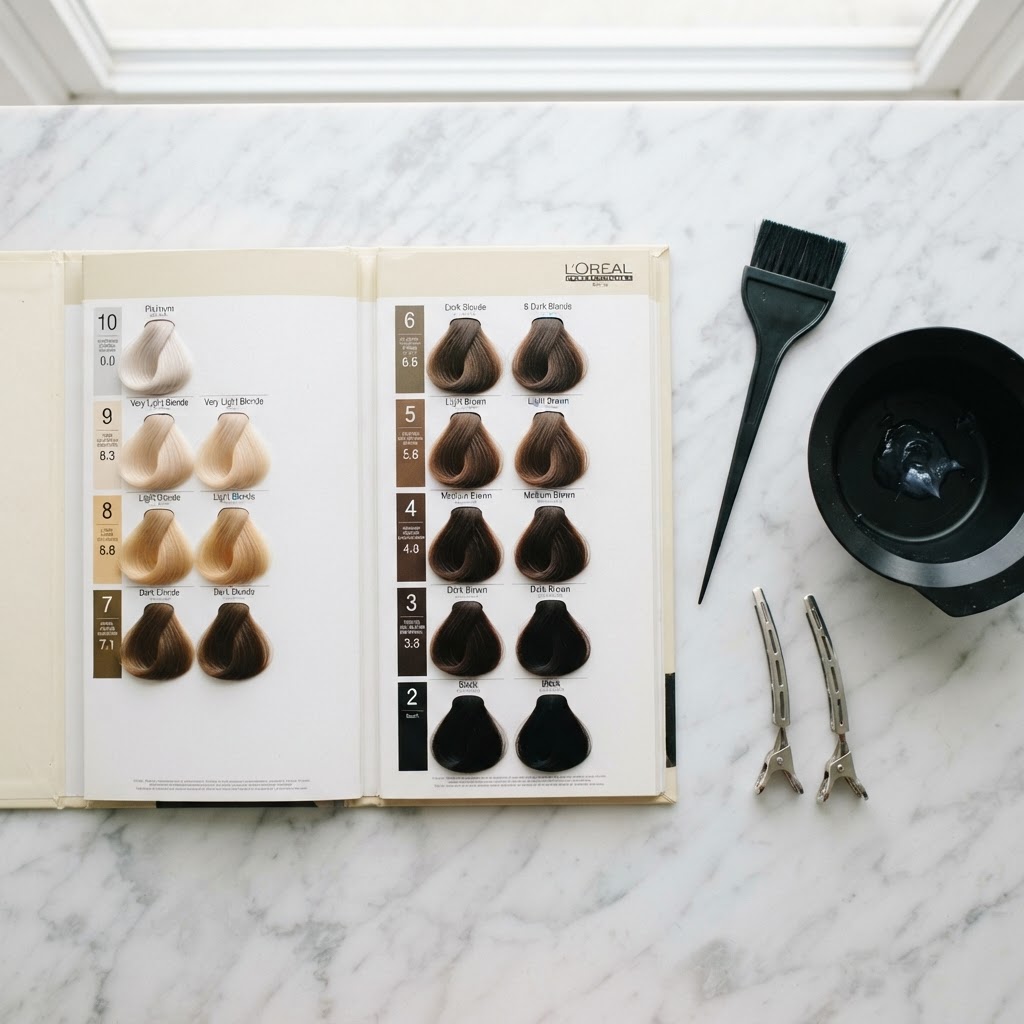
How to Use a Hair Color Chart to Find Your Perfect Shade
Hair Colour Chart, Hair Dye, At-Home Hair Colour, Hair Care, Beauty Tips
Learn how to use a hair color chart to find your perfect shade. Our expert guide explains levels, tones, and how to choose the right hair dye at home.
Why You Need a Hair Color Chart
If you've ever stood in the hair dye aisle feeling overwhelmed by the endless boxes of "Golden Caramel" and "Ashy Mocha," you're not alone. A hair color chart (or hair colour chart, as we say in the UK) is your secret weapon for taking the guesswork out of home dyeing. It is a numbered visual guide that organises every hair shade by its level (how light or dark it is) and its tone (the underlying warmth or coolness) Hair Colour Chart: Understanding Hair Tones and Levels - Rumbie.
Instead of relying on the often-misleading photos on the front of a box, learning to read a shade selector allows you to predict exactly how a dye will interact with your current hair. This means fewer brassy surprises and a much higher chance of achieving that salon-worthy result at home.
Understanding the Numbers: Levels and Tones
Every professional and high-quality box dye uses a universal numbering system. Once you crack the code, choosing a shade becomes incredibly straightforward.
Hair Colour Levels (The First Number)
The first number on a dye box indicates the depth or "level" of the colour, usually on a scale from 1 to 10 What is My Hair Color Level? How it Affects Dye Results.
- Level 1: Black
- Level 2: Very Dark Brown
- Level 3: Dark Brown
- Level 4: Medium Brown
- Level 5: Light Brown
- Level 6: Dark Blonde
- Level 7: Medium Blonde
- Level 8: Light Blonde
- Level 9: Very Light Blonde
- Level 10: Platinum Blonde
Hair Tones (The Second Number or Letter)
The number or letter following the decimal point (or dash) tells you the tone. This is the hue or reflection of the colour Hair Colour Chart: Understanding Hair Tones and Levels - Rumbie.
- .0 or N: Natural (Neutral, no added tone)
- .1 or A: Ash (Cool tone, green/blue base to neutralise red/orange)
- .2 or V: Violet (Cool tone, neutralises yellow)
- .3 or G: Gold (Warm tone)
- .4 or C: Copper (Warm tone)
- .5 or M: Mahogany (Cool/Warm tone)
- .6 or R: Red (Warm tone)
For example, a "6.1" or "6A" is a Dark Ash Blonde, while a "5.3" or "5G" is a Light Golden Brown.
What You'll Need
Before you start mixing, gather your supplies:
- A high-quality hair dye (permanent or demi-permanent)
- The correct developer (see below)
- A tint brush and mixing bowl (avoid metal bowls)
- Sectioning clips
- Gloves and an old towel
- Barrier cream (like Vaseline) for your hairline
Step-by-Step: Choosing and Applying Your Shade
Step 1: Determine Your Starting Level
Isolate a section of your hair from the crown of your head and hold it away from the rest of your hair in good, natural lighting How to find your best hair color using the hair color chart. Match this section to the natural levels on the chart. Be honest with yourself—most people think their hair is darker than it actually is.
Step 2: Identify Your Undertone
Your skin's undertone dictates which hair tones will flatter you most. If you have cool undertones (pink/blue hues, silver jewellery looks best), opt for ash or violet tones (.1, .2). If you have warm undertones (yellow/olive hues, gold jewellery looks best), golden or copper tones (.3, .4) will make your skin glow Hair Dye Color Charts: Read, Match & Pick Your Perfect Shade.
Step 3: Choose Your Developer Volume
If you are using a professional dye where you buy the developer separately, choosing the right strength is crucial Hair Dye Color Charts: Read, Match & Pick Your Perfect Shade:
- 10 Volume: Deposits colour only. Good for going darker or toning.
- 20 Volume: Lifts 1-2 levels and is the standard for 100% grey coverage.
- 30 Volume: Lifts 2-3 levels.
- 40 Volume: Lifts 3-4 levels (use with extreme caution at home).
Step 4: The Patch and Strand Test
Never skip this! Apply a small amount of dye behind your ear 48 hours before colouring to check for allergies. Simultaneously, apply the dye to a hidden strand of hair to ensure you like the colour result and to check the processing time.
Step 5: Application
Apply barrier cream around your hairline. Section your hair into four quadrants. Start applying the dye at the roots (if doing a root touch-up) or mid-lengths and ends (if doing a virgin application), following the specific timing instructions for your chosen developer and dye.
Aftercare for Coloured Hair
To keep your new shade looking fresh:
- Wait 72 hours before washing your hair to allow the cuticle to fully close.
- Use a sulphate-free, colour-safe shampoo and conditioner.
- Wash your hair in lukewarm or cool water; hot water strips colour.
- Use a weekly deep conditioning mask to maintain moisture.
Common Mistakes to Avoid
- Expecting box dye to lighten previously dyed hair: Colour cannot lift colour. If your hair is dyed dark brown, applying a blonde box dye will only damage your hair and leave you with hot roots. You must use a colour remover or bleach first.
- Ignoring underlying pigments: When you lighten hair, it exposes warm underlying pigments (red, orange, yellow). If you are lifting your hair, you must choose a shade with a cool tone (ash or violet) to neutralise this warmth, otherwise, you will end up brassy Hair Dye Color Charts: Read, Match & Pick Your Perfect Shade.
- Leaving the dye on too long: Follow the clock, not your eyes. Leaving dye on longer than recommended won't make the colour better; it will just cause unnecessary damage.
FAQ
Can I mix different hair dye shades?
Yes, but stick to the same brand and product line. Mixing a Level 6 and a Level 8 will generally give you a Level 7 result Hair Dye Color Charts: Read, Match & Pick Your Perfect Shade.
How do I cover stubborn greys?
For resistant greys, use a "Natural" or "Neutral" shade (usually ending in .0 or N) mixed with 20 volume developer. If you want a fashion tone (like red or copper), mix it half-and-half with a natural shade at the same level to ensure full coverage.
What if my hair turns out too dark?
Don't panic. Wash it a few times with a clarifying shampoo or anti-dandruff shampoo, which can help fade the colour slightly. If it's still too dark, you may need a gentle colour remover.
How often can I dye my hair?
For permanent colour, wait at least 6 to 8 weeks between full applications. Root touch-ups can be done every 4 to 6 weeks Hair Dye Color Charts: Read, Match & Pick Your Perfect Shade.