
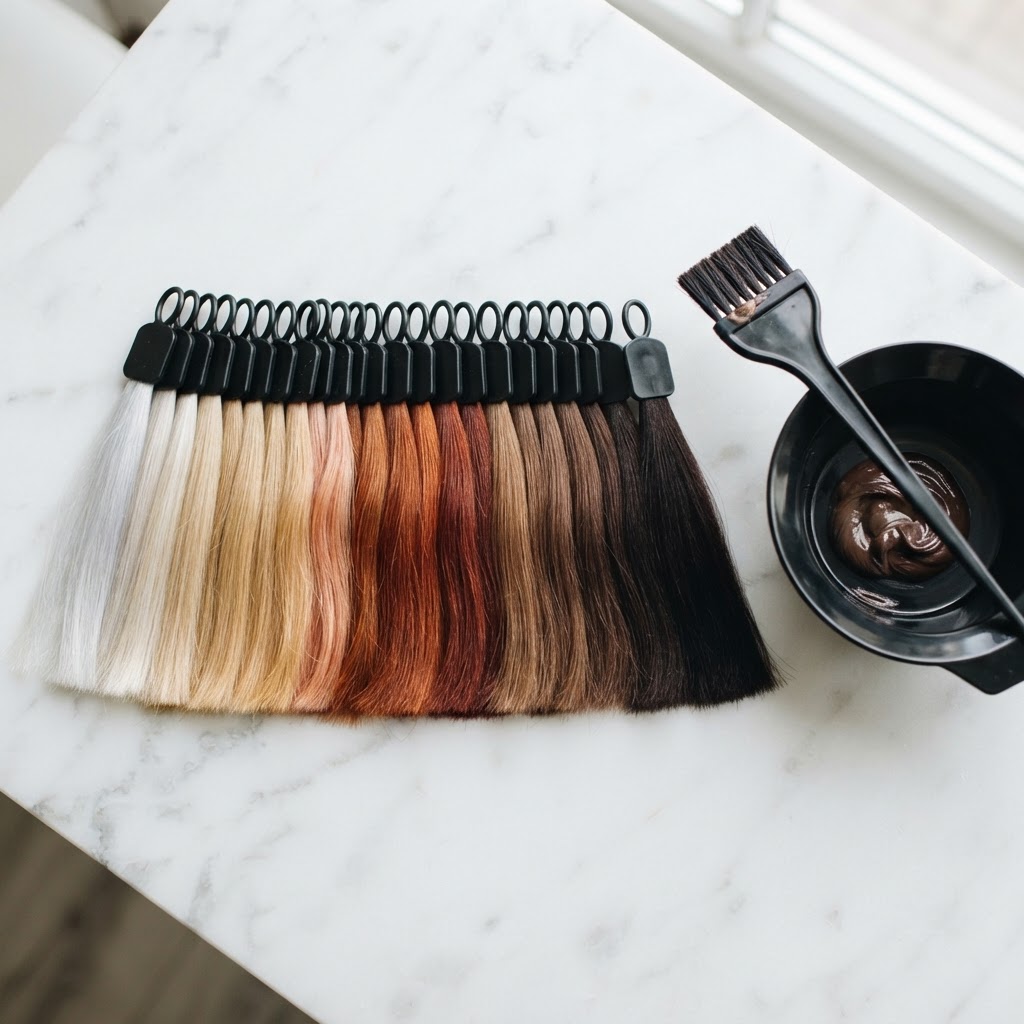
How to Use a Hair Color Chart to Find Your Perfect Shade
Hair Colour, DIY Hair Dye, Hair Color Chart, Hair Care
Discover how to read a hair color chart to find your perfect shade. Our expert guide explains levels, tones, and developers for flawless DIY hair colouring.
Welcome to HairColourChart.online! If you have ever stared at a wall of box dyes or professional tubes in confusion, you are certainly not alone. Learning how to use a Hair Color Chart is the ultimate secret to achieving salon-quality results at home. Rather than relying on the often-misleading photos on the front of a box, a hair colour chart provides a precise, numbered system that tells you exactly how light, dark, warm, or cool a dye will be.
In this comprehensive guide, we will break down exactly how to decode these charts, choose the right developer, and safely transform your hair from the comfort of your own bathroom.
The Anatomy of a Hair Colour Chart
To master choosing a shade, you first need to understand the universal language of hair colour. Most professional and high-quality home dyes use a specific numbering system that is divided into two main parts: the level and the tone.
Hair Colour Levels (The First Number)
Every hair colour chart uses a standard 1 to 10 scale to measure the depth (how light or dark the hair is). As noted by Hair Dye Color Charts: Read, Match & Pick Your Perfect Shade, you can think of this as a brightness dial.
- Level 1: Jet Black
- Level 3: Dark Brown
- Level 5: Light Brown
- Level 7: Medium Blonde
- Level 10: Lightest Blonde
Hair Tones (The Numbers or Letters After the Decimal)
The number or letter following the decimal point (or slash) represents the tone. This is the character of the shade—whether it is warm, cool, or neutral. According to the Neal & Wolf Hair Colour Shade Chart & Numbering System, common tonal numbers include:
- .0 or N: Natural (Neutral)
- .1 or A: Ash (Cool, blue/green base)
- .3 or G: Gold (Warm)
- .4 or C: Copper (Warm)
- .6 or R: Red (Warm)
- .7 or M: Brunette/Mocha (Warm/Neutral)
If you see a double number, like 7.11, this indicates an intense double tone—in this case, a medium blonde with an extra-strong ash tone to neutralise warmth.
What You'll Need for DIY Colouring
Before you begin mixing, ensure you have the right tools for a safe and effective application:
- Your chosen hair dye: Selected using your trusty shade selector.
- Developer: The peroxide lotion that activates the dye.
- Tinting brush and mixing bowl: For precise, professional application (avoid metal bowls).
- Sectioning clips: To ensure even coverage.
- Gloves and a barrier cream: To protect your hands and hairline.
- A timer: To track processing times accurately.
Step-by-Step: Choosing a Shade Using a Hair Colour Chart
Finding your perfect match is a logical process. Follow these steps to ensure you get it right every time.
1. Identify Your Natural Level
Before you can pick a new shade, you need to know where your hair currently sits on the 1-10 scale. Take a section of your hair in natural daylight and hold it against a basic shade chart.
2. Determine Your Target Level
As a golden rule for home colouring, you should only ever lift (lighten) or darken your hair by a maximum of two levels. For example, if you are a natural Level 5 (Light Brown), you can safely achieve a Level 7 (Medium Blonde) at home. Going further than this usually requires bleach and professional colour correction.
3. Choose Your Tone Based on Your Undertone
Your skin's undertone plays a massive role in how a colour looks on you.
- Cool undertones: Look best in ash (.1), violet (.2), or cool reds.
- Warm undertones: Glow in golden (.3), copper (.4), or rich mocha (.7) shades.
- Neutral undertones: Can typically pull off both warm and cool shades.
4. Perform a Patch and Strand Test
Safety first! Always perform an allergy patch test 48 hours before colouring. Simultaneously, do a strand test by applying the mixture to a small, hidden section of hair. This confirms the processing time and ensures the final colour matches your expectations.
Developer Volumes and Timings
Choosing the right developer is just as crucial as picking the right dye. The developer opens the hair cuticle and lifts your natural pigment. Here is a standard guide based on industry practices highlighted by Hair Colour Chart: Understanding Hair Tones and Levels - Rumbie:
- 10 Volume (3%): Best for depositing colour only, going darker, or level-on-level colouring. Does not lift. Processing time: 20-30 minutes.
- 20 Volume (6%): The standard for permanent colour and grey coverage. Lifts the hair by 1 to 2 levels. Processing time: 35-45 minutes.
- 30 Volume (9%): Used for lifting hair up to 3 levels. Processing time: 35-45 minutes.
- 40 Volume (12%): Provides up to 4 levels of lift, usually reserved for high-lift blondes. Warning: Can cause damage if used incorrectly; best left to professionals.
Common Mistakes to Avoid
- Ignoring Underlying Pigment: When you lighten hair, it exposes warm underlying pigments (red, orange, or yellow). If you are lifting a Level 5 to a Level 7, your hair will naturally pull orange. To counteract this, you must use an ash or blue-based tone (.1) to neutralise the brassiness.
- Hot Roots: The heat from your scalp causes dye to process faster at the roots. If you are going lighter, applying the dye to your roots at the same time as your mid-lengths can result in bright, glowing "hot roots." Apply to the lengths first, then the roots.
- Overlapping Bleach or Dye: Applying permanent colour over previously coloured hair can cause banding and severe damage. Only apply permanent dye to the virgin regrowth, and use a gentle demi-permanent gloss to refresh the ends.
Aftercare for Coloured Hair
Once you have achieved your perfect shade, you need to protect it.
- Wait 72 hours before washing: This allows the hair cuticle to fully close, locking in the colour.
- Use colour-safe, sulphate-free shampoo: Sulphates strip colour molecules from the hair rapidly.
- Incorporate a toning mask: If you have dyed your hair blonde or an ash brunette, use a purple or blue shampoo once a week to keep brassy tones at bay.
- Schedule regular touch-ups: Root touch-ups are typically needed every 4 to 6 weeks, depending on your hair growth and the contrast with your natural colour.
FAQ
How do I figure out what colour to dye my hair?
Start by identifying your skin's undertone and your natural hair level. Warm undertones suit golden or copper shades, while cool undertones work beautifully with ash or violet tones. Use a hair colour chart to find a shade that is within two levels of your natural depth for the most flattering, achievable result.
What developer strength should I use for grey coverage?
For covering grey hair, 20 volume (6%) is the industry standard. It provides just enough lift to open the stubborn cuticle of grey hairs, allowing the permanent colour to deposit deeply and evenly.
How do I correct unwanted brassy tones?
To neutralise unwanted tones, you must look at the colour wheel. If your hair has pulled too yellow, use a violet-based toner or shampoo. If it is too orange, you need a blue-based ash tone. If it is too red, a green/matte tone will neutralise the warmth.
By understanding how to read a hair colour chart, you take the guesswork out of DIY dyeing. Take your time, do your strand tests, and enjoy your beautiful new shade!